
Morning sunlight in winter: how to reset your body clock
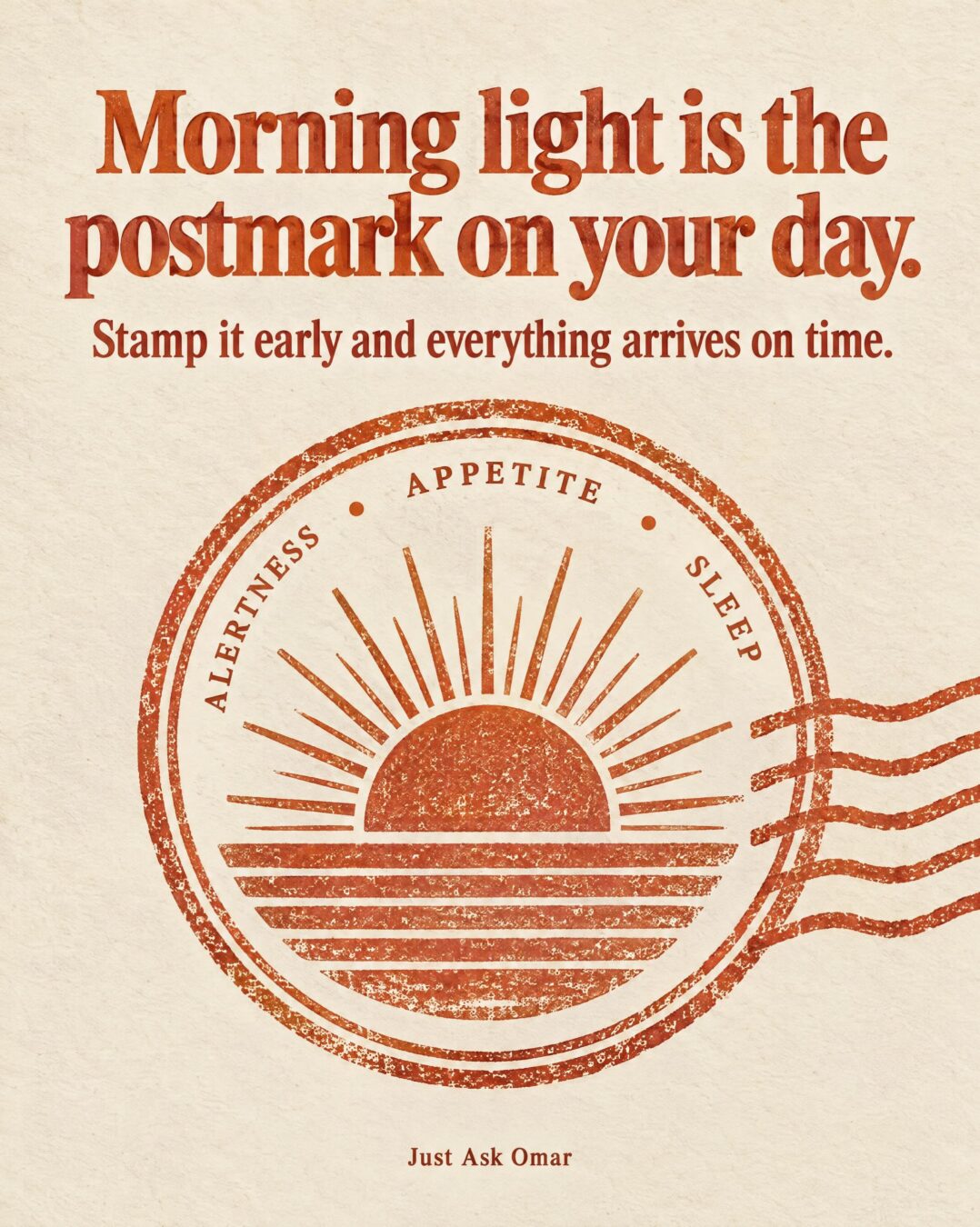
The clocks have gone back, and for a week or two the mornings felt a little brighter. That's already wearing off. By December, plenty of us will leave home in the dark, spend the day under office lights and come home in the dark again.
Then we wonder why we feel flat by mid-afternoon and wide awake at 11pm.
There's a simple reason, and an even simpler habit that helps: morning sunlight, before your screen.
Your body clock resets every morning
Your body runs on an internal clock that sets when you feel alert, when you feel hungry and when you feel ready for sleep. It doesn't run on exactly 24 hours, so it needs nudging back into line every day. Light is the main signal it listens to.
The timing of that light matters. A 2025 study in the Proceedings of the National Academy of Sciences, modelling how light affects the body clock, put it plainly: light in the morning speeds the clock up, and light in the evening slows it down. As the study's senior author explained, you generally need more morning light and less evening light to stay in step with a 24-hour day.
So the question isn't only how much light you get. It's when.
Why winter makes it harder
In summer, morning light finds you whether you look for it or not. In winter it doesn't. The mornings are dim, we go straight from the bedroom to the car or the train, and the first bright thing we see is a phone.
Indoor lighting is a much weaker signal than daylight, even on a grey day. A brightly lit kitchen is nothing like standing outside under a cloudy sky. Meanwhile, bright screens late at night push the clock the other way.
Put the two together, a dim morning and a bright evening, and the clock drifts later. Getting up feels harder, and so does falling asleep.
Remove harm before adding benefit
Before buying a light box or a new supplement, look at what's already working against you. For most people, that's the evening.
- Dim the main lights for the last hour before bed and use lamps instead.
- Put the phone down, or at least turn the brightness right down, before you get into bed.
- Keep the bedroom dark. A streetlight through thin curtains counts.
None of these costs anything. Sometimes the most powerful change is what you stop doing, not what you start.
Then add the morning dose
Once the evening is calmer, give your clock a clear morning signal:
- Step outside within the first hour of waking, even for ten minutes. Cloudy is fine. Never look straight at the sun.
- Do something you already do, outdoors: drink your tea on the doorstep, walk part of the school run, or get off the bus a stop early.
- If you really can't get outside, sit by the brightest window you have, with the curtains fully open, and face the glass.
- Keep it going at weekends. A big lie-in in a dark room undoes the week's good work.
The aim isn't a perfect routine. It's daylight first, screens after.
Quick answers
How long should I spend in morning sunlight in winter? There's no single proven number. Ten minutes outside within the first hour of waking is a realistic start, and longer on a very dull day helps. Consistency matters more than length.
Does it count if it's cloudy? Yes. Outdoor light on a grey day is still far brighter than a well-lit room.
Does light through a window work? It's weaker than being outside, but if you can't get out, sitting close to a bright window is better than nothing.
What a good winter morning looks like
Picture two versions of the same Tuesday.
In the first, the alarm goes at 6.45. You check messages in bed, scroll the news in the kitchen under the ceiling light, drive to work in the half-dark and sit by a monitor until lunch. Your body has had plenty of light, just not the kind that tells it the day has started.
In the second, the alarm goes at the same time. The phone stays on the side while you open every curtain in the house. You take your tea to the back door for five minutes, or walk the long way to the bus stop. You check messages on the train instead.
Same Tuesday, same hours of sleep. One version gives your body clock a clear signal that the day has begun. Over a few weeks, many people find mornings come a little easier and evenings wind down a little sooner.
Signs your clock may be drifting
- You need two alarms and still feel groggy for the first hour.
- Your energy dips hard in the early afternoon.
- You feel tired all evening, then wide awake once you're in bed.
- Weekend lie-ins keep getting longer.
These are common, and they have many possible causes. But if several sound familiar, light timing is a cheap and easy thing to try first.
Everyone is different
Shift workers, new parents and anyone caring for someone at night will need a different pattern, and that's fine. The principle still holds: give your body clear signals of day and night, at roughly the same times, as often as you can.
If tiredness is dragging on for weeks despite decent sleep, it's worth looking at the bigger picture rather than blaming the season, and if you feel unwell or it isn't lifting, see your GP.
Sources: Proceedings of the National Academy of Sciences, 2025: modelling the body clock under permanent standard time, permanent daylight saving time and seasonal clock changes (accessed 16 October 2026); Stanford Medicine news release on the same study, 15 September 2025 (accessed 16 October 2026).