Holistic health assessment
42 questions across all six pillars. Get your score, your weakest area, and your holistic health age.
Best for: a complete picture of your health.
Start my free assessment Part of the RealHealth.Expert family
A free, pharmacist-designed holistic assessment. It scores all six pillars of your health, finds your weakest one, and gives you a clear next step.
About 5 minutes, 42 questions, no signup wall.
Evidence-led, root-cause health that fits you
Generic advice = generic results.Personalised advice = advice that fits you.
Because everyone is different.
Know what you want and want to work with Omar? Find out what he can do for you
You eat reasonably well, you try to sleep, and you take the supplements, and still you feel tired, foggy and not quite yourself. The uncomfortable truth is that generic advice gives generic results, because it was never built around you.
Still tired, foggy, not quite yourself.
Most plans pile on more: more supplements, more rules, more to do. Often the faster win is the opposite, removing what is quietly working against you first. That is where this starts, and it is why everyone needs a different answer.
How this works
Take the assessment, or any tool, and see what is actually driving how you feel. No signup wall.
Your results show your weakest pillar and the highest-leverage place to start. Remove harm first.
When you want it mapped to you, Omar builds the plan around you and walks it with you. See how
Find your starting point
Pharmacist-designed. Pick the one that fits where you are right now.
42 questions across all six pillars. Get your score, your weakest area, and your holistic health age.
Best for: a complete picture of your health.
Start my free assessmentA six-pillar wellbeing reflection for parents of children aged 8 to 12, anchored in evidence.
Best for: checking in on your child's wellbeing.
Open the guideTap the symptoms you're noticing. See which holistic pillars they point to and where to focus first.
Best for: a quick read on your symptoms.
Check my symptomsAfter your assessment
Pharmacist-designed tools to explore a specific area once your assessment has shown you where to look. Free, and honest about what a quick check can and cannot tell you.
A two-stage read on why you are tired: a quick triage, then an optional deeper audit across six pillars, with a calm, honest next step.
Find your patternWatch your energy battery charge and drain as you toggle the everyday habits behind tiredness. A hands-on, visual explainer.
Open the batteryA hands-on look at your cells' tiny power stations, and how everyday inputs and drains move how well they work.
Open the mini-labGo a layer deeper: see how your cells make and spend ATP, the body's energy currency, and what tilts the balance.
Open the ATP labSome medicines quietly draw down a nutrient over months or years. Others make a supplement risky rather than helpful. Tick what you take and see both.
Best for: anyone taking a regular medicine.
Check my medicinesEstimate your personal vitamin D need from your skin, your dress, your age and your UK region. Honest about UK winters.
Open the calculatorA vitamin D estimate calibrated for your modesty practice, skin tone, age and UK home region.
Open the calculatorSee what is actually in sunlight, from UVB through to infrared, and what each part does for your body. A calm, visual explainer.
Explore the spectrumSee the vagus nerve that links your gut and your brain, and watch how everyday habits change the signal. Toggle, compare, and read the evidence behind each one.
Explore the cableA plain-English quick-check for the food additives worth knowing about, including the Southampton Six.
Check additivesLook up 80+ food additives, with halal status surfaced for every entry. Free, and no fluff.
Decode an E-numberAlready know you want help
The 90-Day Personal Programme: one-to-one work with Omar, by application. Five places at a time.
Want a plan to keep, not just the picture? See the three take-home reports
Three free guides from a UK pharmacist: the everyday exposures hiding in your home, and the tricks built into every food label. Every claim sourced. Nothing to buy at the end of any of them.
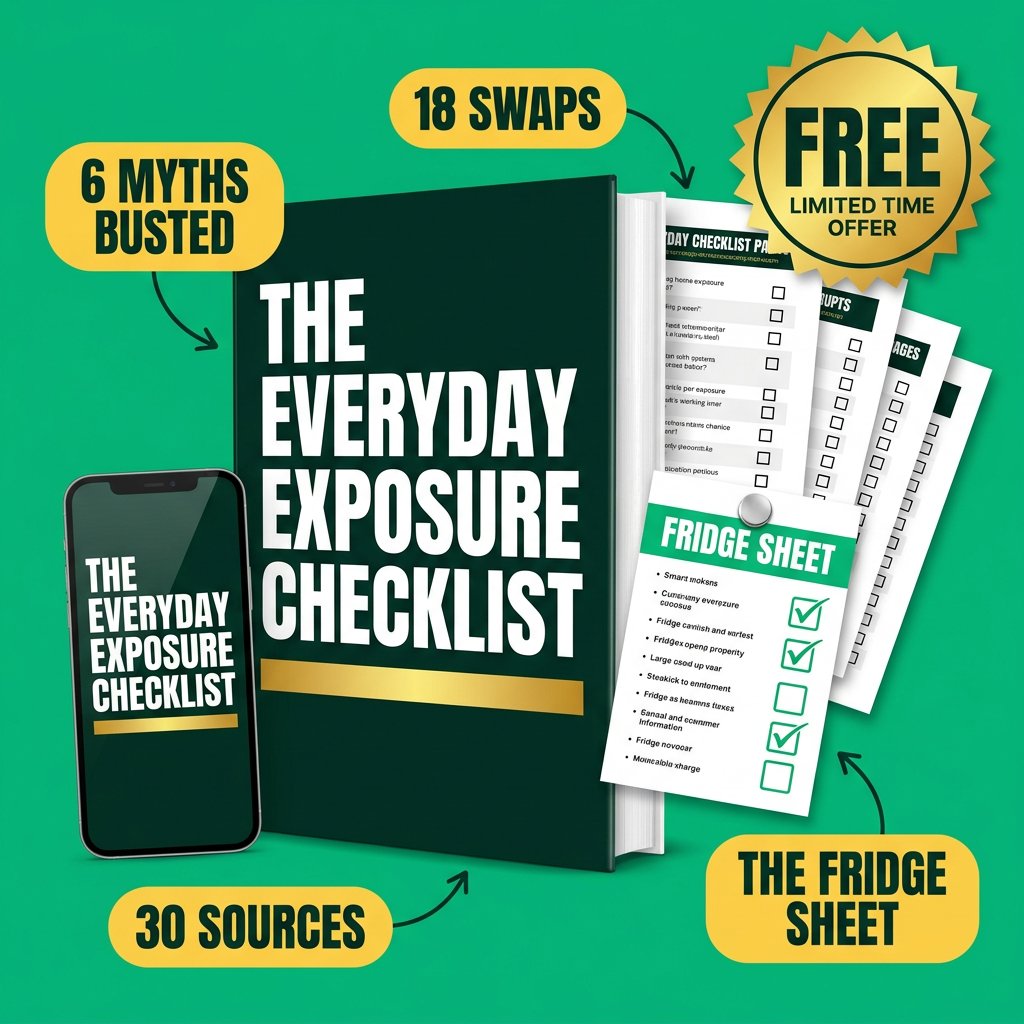
Your whole home, audited room by room.
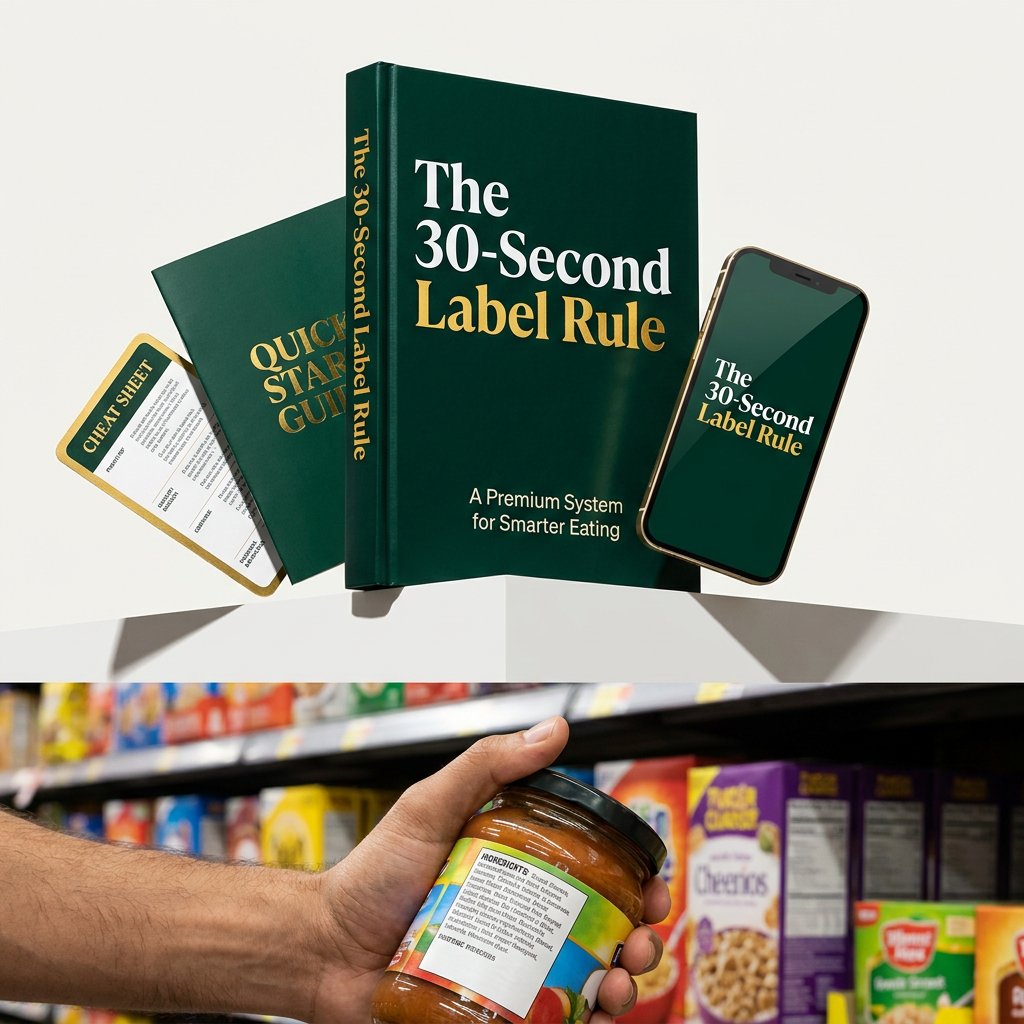
Decode any UK food label in 30 seconds.

The same decoder, rebuilt for the children's aisles.
One email. All three guides land the moment you confirm. No card, no catch.
No spam. Unsubscribe at any time. The guides are yours either way.
Why free? Removing harm first is step one of everything I do. Once you have felt it work, the rest makes sense.
When a free check isn't enough
Three pharmacist-designed tools that don't just show you where you stand, they give you a clear set of next steps. Yours to keep, with a 7-day refund if a report is not for you.
Most people add supplements before removing what is quietly draining them. This audits your kitchen, bedroom, food and personal care, then ranks what to remove first.
Stop guessing why you are exhausted. A 60-question deep dive that names your exact fatigue pattern and the specific factors behind it.
Rebuild your gut over 14 days with a pharmacist-designed, day-by-day plan across plant variety, fibre, fermented foods and eating rhythm.
Most approaches only address what's visible. I look for what's driving it.
Your symptoms are messages, not the problem itself. I listen to what your body is trying to tell you.
Thirty factors go in, across every area of your health. One personalised plan comes out.
Holistic health improvements don't just add years to your life - they add life to your years. Healthspan matters more than lifespan.
A man in the UK lives 79.1 years and is in good health for 60.7 of them. A woman lives 83.0 years and is in good health for 60.9. The rest is lived unwell.
Healthspan is the part you actually feel. The aim is not more years bolted on the end. It is fewer of the ones you already have spent unwell.
Illustrative, not measured. The Energy, Mobility and Joy bars show the contrast between the two, not the result of any study or programme. The figures in the Lifespan card are the Office for National Statistics figures sourced below.
The age, on average, a UK man's good health runs out. He lives to 79.1.
The same for a UK woman. She lives to 83.0.
Years spent in poor health, men and women. And the gap is widening: healthy life expectancy is now the lowest since records began in 2011.
Most people plan for the years. Almost nobody plans for the state they will be in when they get there. Remove the harm early and you are not buying extra years at the end. You are buying back the ones in the middle.
Office for National Statistics: National life tables, UK, 2022 to 2024 (released 10 December 2025) and Health state life expectancies, UK, 2022 to 2024 (released 19 February 2026). Healthy life expectancy counts years lived in self-rated good or very good health, so it is a measure of how you feel, not of diagnosis. Accessed 1 August 2026.
Illustrative, not measured. The rows are the quality-of-life facets used in the WHO WHOQOL-BREF framework: energy and fatigue, sleep and rest, thinking and concentration, pain and discomfort, positive feelings, and mobility. The bars show the contrast between living with symptoms and living well, not the result of any study or programme. Everyone is different. The two charts below carry their own sources.
Eliminating bad habits is linked to measurable, long-term benefits.
Average additional life expectancy from eliminating each habit
Approximate population-level estimates; individual results vary. Years figures: smoking (Doll, BMJ 2004; the full 10 years is for stopping by around age 30, and the study followed male doctors, with stopping at 40, 50 or 60 gaining about 9, 6 or 3 years), diet (Fadnes, PLOS Medicine 2022; about 8 years from age 60 on an optimal diet, and higher from younger ages), exercise (Moore, PLOS Medicine 2012; 4.5 years is the upper end, at 450 minutes or more a week, and the recommended 150 minutes a week came with about 3.4 years), alcohol (Wood, Lancet 2018). The 2 years for alcohol is the upper end of the 200 to 350 grams a week band, roughly 25 to 44 UK units; Wood reports lower life expectancy at age 40 of about 6 months, 1 to 2 years, and 4 to 5 years across the rising bands, so the heaviest drinkers stand to gain most and lighter drinkers less. Wood compares against people already drinking lightly, at 100 grams a week or under, not against people who drink nothing. Quality sleep and stress management are shown as protective rather than as a number of years, because the years cannot be quantified the same way, but the link itself is well evidenced: sleep (Cappuccio, Sleep 2010), positive wellbeing and mortality (Chida and Steptoe, Psychosomatic Medicine 2008), psychological distress and mortality (Russ, BMJ 2012).
How holistic lifestyle changes reduce your risk
Approximate population-level estimates; individual results vary. Type 2 diabetes (Hu, NEJM 2001), heart disease (Stampfer, NEJM 2000) and stroke (Chiuve, Circulation 2008) are figures for women; stroke is total stroke, and the figure is higher again for ischaemic stroke. Chiuve followed men as well, where the same low-risk pattern accounts for 35% of total stroke rather than 47%. Depression (Zhao, Nature Mental Health 2023) compares a favourable lifestyle with an unfavourable one. Dementia (Livingston and colleagues, Lancet standing Commission 2024) is the share of cases across the population attributable to fourteen modifiable risk factors, updated from twelve factors and 40 per cent in the 2020 report. That is a population figure, not a personal one: it is what could in theory be prevented if those fourteen risks were removed across everyone, not the amount any one person can cut their own risk by. Cancer (Cancer Research UK, 2018) is the share of UK cases attributable to known risk factors.
World Health Organization, Executive Board document EB109/14, 109th Session. Individual risk varies, and these are what could be avoided across a population rather than a promise to any one person. Accessed 3 August 2026.
Every figure above is a population average. None of them is about you. Yours depends on what is already working against you, and that is different for everyone: your sleep, your gut, your stress load, what you are exposed to at home and at work.
You cannot remove harm you have not found yet. The assessment walks through the whole picture and shows you what to deal with first.
Start my free assessmentFree, takes about ten minutes, and you get your results on screen.
Most approaches fix one piece. I look at all four - because they're deeply connected.
Nutrition, movement, sleep, detox, natural remedies
Stress, clarity, focus, cognitive health, emotional balance
Mood, resilience, gratitude, meaning, inner peace
Home toxins, EMF, air quality, water, daily surroundings
Flip the switch to see the difference.
Random Tips = Random Results
Personalised Plan = Real Results
Your health deserves more than random internet advice
"Wow, I thought I knew everything about health but you've just totally made me realise I don't know that much. You need to write a book and tell people about this!"
- S. Hussain"The advice I've received from this programme was superb. It helped me improve my lifestyle in ways I couldn't imagine. I highly recommend it."
- C. MohammedReal client experiences, edited for length and shared with permission. Results vary, everyone is different.